
EDT, EDP, Extrait: What the Label on Your Perfume Actually Means
"More oil. Less alcohol. Still there at dinner."
Most people choose perfume by smell, by brand, or by whatever their friend is wearing. Very few look at the two or three small words printed near the bottom of the bottle.
They should. Those words tell you how much fragrance is actually in there, how long it will last on your skin, and whether you're paying for perfume or mostly for alcohol.
First, what's in a bottle of perfume?
Every perfume is a blend of three things: fragrance oils (the part that smells), alcohol (which carries the oils and helps them spread when you spray), and sometimes a little water.
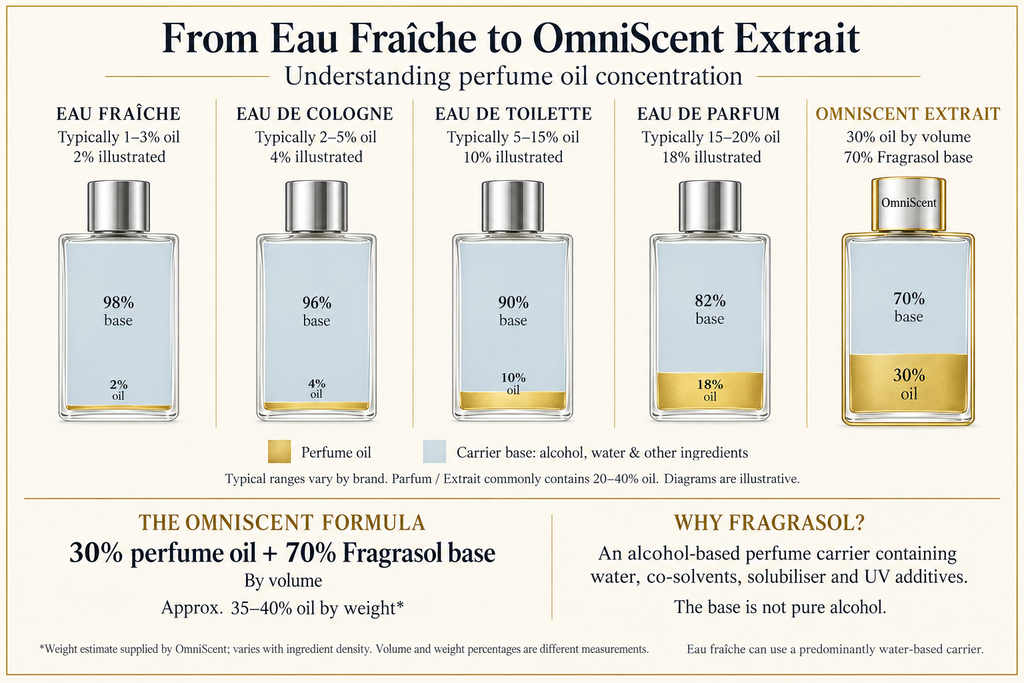
The concentration is simply the percentage of fragrance oil in the mix. More oil means a richer scent that develops slowly and stays on your skin for longer. More alcohol means a lighter scent that opens brightly and fades faster.
That's it. Everything else on the label is detail.
The five concentrations, from lightest to richest
There's no global law setting exact percentages, so brands vary. These are the ranges the industry generally works to:
| Name | Typical oil concentration | Typical wear on skin |
|---|---|---|
| Eau Fraîche | 1–3% | Around 1 hour |
| Eau de Cologne (EDC) | 2–5% | 2 hours or so |
| Eau de Toilette (EDT) | 5–15% | 3–5 hours |
| Eau de Parfum (EDP) | 15–25% | 5–8 hours |
| Extrait de Parfum | 30–40% | 8 hours and beyond |
Wear times depend a lot on your skin, the weather and the notes in the fragrance itself. A citrus EDT will always fade faster than an amber one. But the pattern holds: the higher the oil, the longer it stays.
Eau Fraîche and Eau de Cologne are refreshers. Think a splash after the gym or on a hot afternoon. Pleasant, brief, and gone by lunch.
Eau de Toilette is where most designer "fresh" fragrances live. Bright in the first hour, then noticeably softer. If you've ever found yourself reapplying at 2pm, you were probably wearing an EDT.
Eau de Parfum is the most common concentration in the premium market. Fuller, warmer, and it lasts almost working day for most people.
Extrait de Parfum (also called parfum or pure perfume) is the richest form a fragrance can take. More oil, less alcohol. It's chemistry doing its best work. This is what OmniScent produces.
Why extrait is worth it
It lasts. This is the obvious one. With the highest oil concentration, extrait holds on through the day and often into the evening. Still there at dinner. Ask your colleagues.
It develops properly. Perfume is built in layers: top notes you smell first, heart notes that arrive after 20 minutes or so, and base notes that carry the scent for hours. In lighter concentrations, the base can be thin by the time you get to it. Extrait gives every layer enough material to show up.
It wears closer to you. Because there's less alcohol, extrait doesn't blast out in a cloud when you spray it. It sits nearer the skin and radiates steadily. People notice it when they're near you, which is exactly where you want them to notice it.
It's better value per wear. This is the part most people miss. Say a 65ml extrait costs R250. At roughly 0.1ml per spray, that's around 650 sprays. At three sprays a day, it's over 200 days of wear for about R1.20 a day. And because you're not reapplying at lunch, those three sprays are actually enough. A cheaper, lighter perfume that needs topping up twice a day isn't cheaper at all.
It layers better. If you've started layering fragrances, extrait gives you two rich scents that hold together long enough to blend, rather than two light ones that fade before they've met.
When a lighter concentration makes sense
To be fair to the others: an EDT or cologne has its place. On a 34-degree January day in Joburg, at the gym, or anywhere you want a scent that's gone in an hour, lighter is better. With OmniScent, you can spray less and get a similar effect.
But if you want one bottle that works from the morning meeting to the evening out, extrait is the one to reach for. You can always wear less of it on a hot day. You can't make a light fragrance last longer by wishing.
How to get the most out of extrait
Two or three sprays is plenty. It's concentrated. Start small and add if you need to.
Aim for pulse points. Wrists, neck, behind the ears and the inside of the elbows. These spots are warmer, which helps the fragrance lift gently through the day.
Spray on moisturised skin. Fragrance holds far better on hydrated skin. An unscented lotion first makes a noticeable difference.
Don't rub your wrists together. It flattens the top notes before anyone gets to smell them.
DO NOT STORE perfume in the bathroom. Heat, humidity and sunlight break fragrance down over time. A cool, dark drawer or cupboard keeps it smelling the way it should.
Don't trust your own nose after an hour. Your brain tunes out a familiar smell quickly, which is why you might think your perfume has faded when everyone around you can still smell it. Resist the urge to reapply.
Why OmniScent makes extrait
When we started OmniScent, we had a choice. We could make lighter fragrances and charge less, or make extrait and charge sensibly. We chose extrait, because a perfume that disappears by lunchtime isn't a bargain. It's just a short one.
Every OmniScent fragrance is made to extrait strength, so you get the full development of the scent, the long wear, and the trail that makes people ask what you're wearing, at a price that makes sense for something you'll use every day.
Explore the OmniScent range and read the small print for yourself. It says EXTRAIT PARFUM on every bottle.


